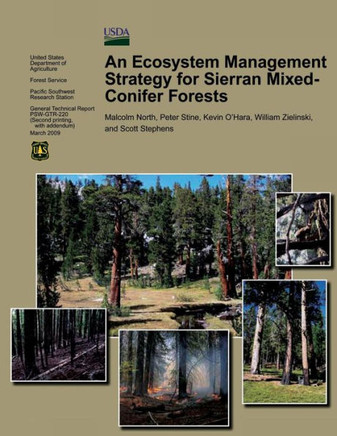
In recent years, there has been substantial debate over Sierra Nevada forest management. All perspectives on this debate inevitably cite "sound science" as a necessary foundation for any management practice. Over the dozen years since publication of the last science summary, the Sierra Nevada Ecosystem Project (SNEP 1996), many relevant research projects have published findings in dozens of scientific journals, yet these have not been synthesized or presented in a form that directly addresses current land management challenges. Current management usually cites a "healthy forest"1 as a primary objective. It is difficult, however, to define forest "health," and, as a broad concept, "a healthy forest" provides few specifics to guide management or assess forest practices. Various constituencies have different ideas of forest health (i.e., sustainable timber production, fire resilience, biodiversity, etc.) making forest health unclear as an objective (Kolb et al. 1994). A premise of silviculture is that forest prescriptions can be tailored to fit a wide variety of land management objectives, once those objectives are defined. We attempt to define some of the key management objectives on National Forest System lands in the Sierra Nevada and how they might be approached through particular silvicultural prescriptions. In this paper, we focus on summarizing forest research completed at different scales and integrating those findings into suggestions for managing forest landscapes. Although many experiments and forest treatments still occur at the stand level, ecological research and recent public input have emphasized the need to address cumulative impacts and coordinate management across the forest landscape. We believe our synthesis has some novel and highly applicable management implications. This paper, however, is not intended to produce new research findings for the academic community; rather it is an effort to provide managers of Sierran forests with a summary of "the best available science." Some of the suggestions in this paper are already used in different Forest Service management practices. There are several aspects of forest management that this paper does not address, but we would like to particularly note two omissions. The USDA Forest Service is charged with multiple-use management, which can include more objectives (e.g., socioeconomic impacts) than our focus on ecological restoration of Sierran forests. Restoration practices need both public and economic support to be socially and financially viable. Also, we do not specifically address the issues of water yield and quality in this paper, although water is one of the Sierra's most important resources. Although our focus is on forest conditions, the suggested management practices may also make forests more resilient to disturbances including climate change. Management practices that help restore the forest headwaters of Sierran watersheds will benefit water production and quality for downstream users.
| Author: Peter Stine |
| Publisher: Createspace Independent Publishing Platform |
| Publication Date: Oct 22, 2012 |
| Number of Pages: 68 pages |
| Binding: Paperback or Softback |
| ISBN-10: 148016478X |
| ISBN-13: 9781480164789 |