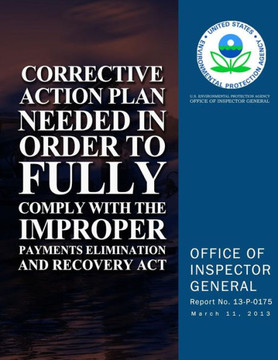
As Congress searches for ways to generate savings, reduce the deficit, and fund federal programs, it has held hearings and passed legislation to prevent and recover improper payments. Improper payments-which exceeded $115 billion in FY2011-are payments made in an incorrect amount, payments that should not have been made at all, or payments made to an ineligible recipient or for an ineligible purpose. The total amount of improper payments may be even higher than reported because several agencies have yet to determine improper payment amounts for many programs, including some with billions of dollars in annual expenditures. In 2002, Congress passed the Improper Payments Information Act (IPIA, P.L. 107-300; 116 Stat. 2350), which established an initial framework for identifying, measuring, preventing, and reporting on improper payments at each agency. That same year, Congress also passed legislation, the Recovery Audit Act (P.L. 107-107; Section 831; 115 Stat. 1186), which required agencies that awarded more than $500 million annually in contracts to establish programs to recover overpayments to contractors. After five years of reporting, the data indicated that while many individual programs reduced their improper payment rates, the total amount of improper payments and the government-wide improper payment rate both increased. Since the IPIA reporting requirements took effect, agencies have expanded the number of programs reported each year. One potential consequence of this expansion is that the annual dollar amount of improper payments reported has more than doubled over time from $45 billion in FY2004 to $115 billion in FY2011. In response, Congress passed new legislation, the Improper Payments Elimination and Recovery Act of 2010 (IPERA, P.L. 111-204; 124 Stat. 2224), which replaced and consolidated the requirements of both IPIA and the Recovery Audit Act. IPERA retained the core provisions of the IPIA while requiring improvements in agency improper payment estimation methodologies and improper payment reduction plans. It also significantly expanded the scope and reporting requirements of recovery audit programs. This publication examines the key provisions of IPERA and analyzes its effectiveness at reducing improper payments and increasing payment recoveries. IPERA may have had a positive impact on efforts to recoup overpayments-agencies recaptured more than $1.2 billion in improper payments in FY2011, which is nearly double that recaptured in FY2010. Legislation introduced in the 112th Congress would address some of the weaknesses in agency improper payment prevention controls and recovery audit programs. S. 1409, the Improper Payments Elimination and Recovery Improvement Act, passed the Senate with an amendment by unanimous consent in August 2012 and was then sent to the House and referred to the Committee on Oversight and Government Reform. The House passed a companion version of the bill, H.R. 4053, the Improper Payments Elimination and Recovery Improvement Act of 2012, on December 13, 2012, by a vote of 402-0.
| Author: Meredith a. Levine |
| Publisher: Createspace Independent Publishing Platform |
| Publication Date: Jan 05, 2013 |
| Number of Pages: 26 pages |
| Binding: Paperback or Softback |
| ISBN-10: 1481914774 |
| ISBN-13: 9781481914772 |