


Createspace Independent Publishing Platform
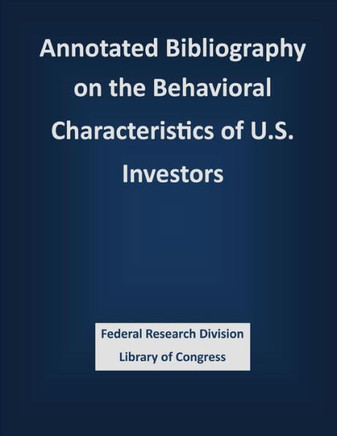
Annotated Bibliography on the Behavioral Characteristics of U.S. Investors
Product Code:
9781503339088
ISBN13:
9781503339088
Condition:
New
$17.47
Annotated Bibliography on the Behavioral Characteristics of U.S. Investors
$17.47
Investor behavior is a hotly debated topic within the academic community. One relatively new area of study is the field of behavioral finance, which highlights departures from rational behavior in investing. Behavioral finance theory poses a challenge to many of the long-established assumptions of the rational expectations school of thought, which posits that people (investors) maximize utility (returns), acting rationally and in their self-interest. By focusing on the psychological and behavioral elements in the determination of stock prices, behavioral finance also challenges the efficient market hypothesis (EMH), which holds that market prices reflect all known information. EMH, developed by University of Chicago economist and Nobel Laureate Eugene Fama, implies that beating the market by identifying undervalued securities is impossible. Whether EMH remains valid is beyond the scope of this annotated bibliography, which is more concerned with investor behavior than with market efficiency. In other words, how the market behaves is not relevant here. Instead, the focus of this bibliography is on how investors behave and on how investor education may help them avoid common mistakes. This bibliography covers the last 15 years. This annotated bibliography draws primarily on the work of economists and finance professors, who support their conclusions with extensive statistical models based on actual investor activity. However, the bibliography also provides references from the social sciences, such as psychology and sociology, because behavioral finance is a multidisciplinary field, spanning a wide range of socioeconomic analyses. For example, risk aversion is related to the psychological concept of prospect theory. Princeton psychologist and Nobel Laureate Daniel Kahneman and the late psychologist Amos Tversky, who was last affiliated with Stanford University, developed prospect theory to explain how people maximize value or utility in choosing between alternatives that involve risk. Kahneman's article, "Aspects of Investor Psychology," co-authored with Charles Schwab executive Mark W. Riepe, is included in this bibliography. The perspective of sociology is represented in the article, "Financial Manias and Panics: A Socioeconomic Perspective," by York University economist Brenda Spotton Visano, who shows how sociologists' theories shed light on the phenomena of manias and panics. Similarly, in the article, "On Financial Frauds and Their Causes: Investor Overconfidence," Steven Pressman, an economist at Monmouth University, maintains that empirical psychology, which analyzes how people make choices when confronted with uncertainty, offers a better explanation of how Ponzi schemes thrive than neoclassical economics, which emphasizes the role of asymmetric information in risky situations. Even neuroscience can illuminate investor behavior: in "Affect and Financial Decision-Making: How Neuroscience Can Inform Market Participants," a physician, Dr. Richard L. Peterson links risk avoidance and risk taking to separate brain systems. The 52 abstracts in the bibliography are arranged according to the following categories, with the number of abstracted articles in each category provided in parentheses:
| Author: Federal Research Division Library of Con |
| Publisher: Createspace Independent Publishing Platform |
| Publication Date: Nov 25, 2014 |
| Number of Pages: 44 pages |
| Binding: Paperback or Softback |
| ISBN-10: 1503339084 |
| ISBN-13: 9781503339088 |
Related Products

Createspace Independent Publishing Platform
Behavioral Pattern and Pitfalls of U.S. Investors
$15.75

Createspace Independent Publishing Platform
Behavioral Patterns and Pitfalls of U.S. Investors
$17.47

Createspace Independent Publishing Platform
U.S. Marines in the Persian Gulf, 1990-1991: Anthology and Annotated Bibliography
$20.09
