


Birkhäuser
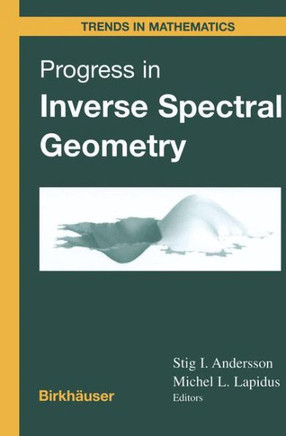
Progress in Inverse Spectral Geometry
Product Code:
9783764357559
ISBN13:
9783764357559
Condition:
New
$61.47

Progress in Inverse Spectral Geometry
$61.47
most polynomial growth on every half-space Re (z)::::: c. Moreover, Op(t) depends holomorphically on t for Re t > O. General references for much of the material on the derivation of spectral functions, asymptotic expansions and analytic properties of spectral functions are [A-P-S] and [Sh], especially Chapter 2. To study the spectral functions and their relation to the geometry and topology of X, one could, for example, take the natural associated parabolic problem as a starting point. That is, consider the 'heat equation': (%t p) u(x, t) = 0 { u(x, O) = Uo(x), tP which is solved by means of the (heat) semi group V(t) = e-; namely, u(-, t) = V(t)uoU- Assuming that V(t) is of trace class (which is guaranteed, for instance, if P has a positive principal symbol), it has a Schwartz kernel K E COO(X x X x Rt, E* (R)E), locally given by 00 K(x, y; t) = L>-IAk( k (R) 'Pk)(X, y), k=O for a complete set of orthonormal eigensections 'Pk E COO(E). Taking the trace, we then obtain: 00 tA Op(t) = trace(V(t)) = 2:: >- k. k=O Now, using, e. g., the Dunford calculus formula (where C is a suitable curve around a(P)) as a starting point and the standard for- malism of pseudodifferential operators, one easily derives asymptotic expansions for the spectral functions, in this case for Op.
| Author: Stig I. Andersson |
| Publisher: Birkhauser |
| Publication Date: Oct 01, 1997 |
| Number of Pages: 197 pages |
| Binding: Hardback or Cased Book |
| ISBN-10: 376435755X |
| ISBN-13: 9783764357559 |
Related Products

World Scientific Publishing Company
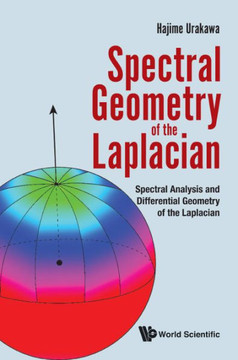
Spectral Geometry of the Laplacian: Spectral Analysis and Differential Geometry of the Laplacian
$125.22

