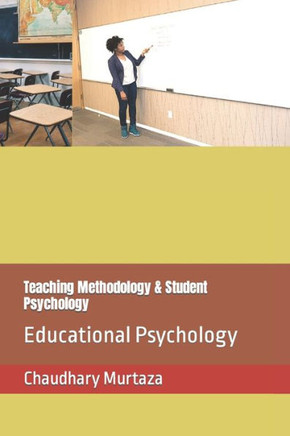
Teaching Methodology & Student Psychology comprises the principles and methods adopted by teachers to enable student learning. The management strategies used for classroom instruction is called Teaching Methodology. Teaching Strategies are determined by the nature of learner. Effective Teaching Strategies are necessary for better student learning. Effective Teacher Learning and professional development is important for student achievement. Teaching Methodology is a process that promotes teachers' teaching skills. The best of Teaching Methodology is to control Student attention.The most basic teaching method is explanation. Explanation is characterized by its function as "a tool that is used by a speaker for understanding or 'giving a sense' to the object of communication, of a debate, or a discussion. The role of an explanation is to make clearer the meaning of an object (method, term, assignment) maintaining formally the necessary distance between the object of the action or study and the tools. In the learning/teaching process, explanation is a tool used by both, teacher and students. Its goal is to manifest comprehension.Traditionally, explanation belongs to such teaching methods where the information is transmitted from the teacher to the students (together with e.g. narrative, description or lecture). Skalkov?, 1999, says that in practice, individual forms of explanation often percolate. In this perspective, explanation is seen as the task fulfilled by the teacher with students passively receiving what is presented. Collecting feedback on students' perceptions of whether explanations are clearly identified whether students feel particular teaching assisted them in understanding the subject matter. Without student understanding, no explanation can be said to be clear We see explanation in a much broader sense.Communication in school is a mutual interchange of information among teachers and students.Student Psychology is always discussed in Educational Psychology. Educational psychology in turn informs a wide range of specialities within educational studies, including instructional design, educational technology, curriculum development, organizational learning, special education, classroom management, and student motivation. Student psychology both draws from and contributes to cognitive science and the learning sciences. In universities, departments of educational psychology are usually housed within faculties of education, possibly accounting for the lack of representation of educational psychology content in introductory psychology textbooks as well special attention to student psychology.Student Psychology and Educational psychology has seen rapid growth and development as a profession in the last twenty years. School psychology began with the concept of intelligence testing leading to provisions for special education students, who could not follow the regular classroom curriculum in the early part of the 20th century. However, "school psychology" itself has built a fairly new profession based upon the practices and theories of several psychologists among many different fields. Educational psychologists are working side by side with psychiatrists, social workers, teachers, speech and language therapists, and counselors in an attempt to understand the questions being raised when combining behavioral, cognitive, and social psychology in the classroom setting.Using psychology in the classroom has always been an essential component of education, helping teachers to refine and develop instructional methods and create learning-rich classrooms. Psychology also helps teachers use measurements and assessments correctly, to better gauge where students are in their learning.The first eight principles highlight some of the most important findings on teacher practices that impact student growth.Growth mindsetPrior knowledgeLimits of stage theoriesFacilitating contextPracticeFeedbackSelf-regulationCreativity
| Author: Chaudhary Murtaza |
| Publisher: Independently Published |
| Publication Date: Apr 07, 2021 |
| Number of Pages: 102 pages |
| Binding: Paperback or Softback |
| ISBN-10: NA |
| ISBN-13: 9798734497166 |