The Summa Theologica, one of the magnum opus of Christian theology, penned by Saint Thomas Aquinas in the 13th century, stands as one of the most extensive and meticulous explorations of Christian doctrines. This seminal manuscript finds itself in a context where the marriage of faith and reason was a sharply investigated matter. Saint Thomas Aquinas, a Dominican friar and scholastic theologian, set out to systematize Christian doctrine with unprecedented intellectual rigor, drawing upon Aristotelian empiricism, divine revelation, and ecclesiastical teachings.
Regarding its history, the Summa Theologica was to some extent a response to Summa Contra Gentiles, another work by Aquinas, more geared towards apologetics and inter-religious dialogue. Completed between 1265 and 1274, the work has been the subject of numerous editions and translations, as well as commentary and interpretation by subsequent theologians and philosophers. Of particular interest is its unfinished conclusion, interrupted by the death of Thomas Aquinas. The work was not just a treatise but a continuous and dynamic effort of theological conciliation and exploration.
Some curious facts further enhance its notoriety. For instance, during the Council of Trent, between 1545 and 1563, the Summa Theologica was placed on the altar alongside the Bible, signaling its authoritative status on matters of faith. Another interesting aspect is the influence of Aristotelianism on the work, which sparked debates and even controversies, especially during the Renaissance and Protestant Reformation, periods when the marriage between philosophical reason and the principles of faith was questioned.
In conclusion, the Summa Theologica is not merely a theological work but a philosophical and juridical encyclopedia of Christian thought.
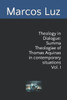
In writing "Theology in Dialogue," my intention was to extend a welcoming hand to you, dear reader, and guide you through a theological garden that, although deeply rooted in complex issues such as "soteriology" and "eschatology," blossoms in simple and accessible language.
Think of this book as a cozy caf?, situated at the corners of theology, where dense spiritual questions are turned into palatable conversations. Here, we don't sit in academic halls with an air of gravity, but in friendly spaces that encourage reflection and the quest for spiritual understanding.
The choice to utilize characters like Thomas and Gabriel, Leonardo, Sofia, Amanda, Mariane, and many others was not merely stylistic, but a sincere attempt to make theology alive and pulsing. They serve as our companions on this journey, our mediators between intellect and emotion, allowing the complexity of theology to be tempered by pastoral sensitivity. They are, in many ways, the personification of our own duality as rational and emotional beings, seeking to balance faith and reason in a fragmented world.
This book does not shy away from difficult questions. On the contrary, it faces them head-on, but does so with a clarity that allows both the neophyte and the erudite to appreciate the richness of the material.
It's a work that invites you to dive deep into the faith questions that shape our understanding of the divine and the human, without the barrier of technical language that often alienates those not versed in theology. So, I invite you to delve into this work.
See "Theology in Dialogue" as an investment, not just in your intellect, but in your spiritual journey. It is a book aimed not only to enrich your theological understanding but also to nourish your soul. It is a devotional that speaks the language of the soul and the intellect, a treasure waiting to be discovered by all who seek a richer and well-founded spiritual life. Therefore, dear reader, the invitation is made. Come be part of this incredible journey of faith and understanding.
The garden is open, and the conversation has already begun.
| Author: Marcos Luz |
| Publisher: Independently Published |
| Publication Date: Oct 07, 2023 |
| Number of Pages: 536 pages |
| Binding: Paperback or Softback |
| ISBN-10: NA |
| ISBN-13: 9798863714875 |