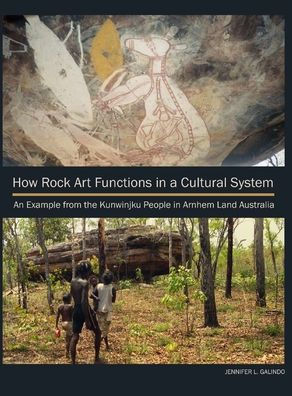
This book provides a firsthand account of how rock art functions as part of a living cultural system, that of a group of Aboriginal people in Northern Australia.
The information in this book has two voices. The first is presented as transcripts of conversations with Kunwinjku individuals. The second is the archaeologist's ethnoarchaeological analysis of the information gathered.
The bulk of the ethnographic data centers on one clan estate in the country of Kudjekbinj. Its people share their Dreaming stories, and the places on the landscape associated with them, thereby describing their culture and the country on which they live. The various contexts of their culture's rock art are explored. Details of each site are shared: the paintings, their purpose and background story, the significance of their location, and the works believed to have been created by the Dreaming Beings versus those painted by the Kunwinjku people.
Also presented is an ethnoarchaeological analysis that examines how rock art operates on different scales within the Kunwinjku cultural system. This includes how function varies at each scale: that of a single clan estate, between neighboring clan estates, and within the larger region.
While the information shared in this book centers on a small population of Kunwinjku people in Northern Australia, the knowledge gained has wide-reaching implications for rock art research outside of Australia. This study shows that, without ethnographic information, archaeologists would not be able to access the original meaning of a motif or recreate the story associated with it. But, based on the scale of the distribution of specific motifs, it could be possible to address questions relating to social units.
One of the lessons learned is that rock art cannot be studied in isolation. To understand the role of rock art in a social system requires considering it in association with environmental, ethnoarchaeological, and archaeological data, and incorporating theories developed in these other disciplines when interpreting patterns identified in rock art analysis. Using what was learned from this ethnoarchaeological project a framework is proposed to better interpret distributional patterns in archaeological rock art motifs when ethnographic information is lacking.
| Author: Jennifer Galindo |
| Publisher: Ethno-Archeo Services |
| Publication Date: Jul 03, 2023 |
| Number of Pages: 186 pages |
| Binding: Hardback or Cased Book |
| ISBN-10: NA |
| ISBN-13: 9798989016013 |